

This article provides an overview of the Earth’s internal structure, focusing on the three main layers: the crust, mantle, and core. Understanding these layers is essential for studying geology and the processes that shape our planet.
The Earth is composed of distinct layers, each with unique properties and compositions. This model illustrates how these layers interact and contribute to geological phenomena.
Understanding Earth’s Layers
The Earth is composed of distinct layers, each with unique properties and compositions.
These layers play a significant role in the geological processes that shape our planet.
The three main layers are the crust, mantle, and core, each contributing to the dynamic nature of Earth.
The Crust: Our Living Surface
The Earth’s crust is the thin, outermost layer where all life exists.
It consists of solid rock and minerals, forming both continental and oceanic crust.
The thickness of the crust varies, with continental crust being thicker than oceanic crust, which influences geological activity.
This layer is crucial for supporting ecosystems and human activities, as it contains the resources we rely on, such as minerals and fossil fuels.
The Mantle: The Thick Middle Layer
Beneath the crust lies the mantle, a thick layer composed of semi-solid rock.
The mantle is rich in silicate minerals, particularly those containing iron and magnesium.
It is divided into the upper and lower mantle, with the upper mantle being partially molten, allowing for slow movement over geological time.
This movement is responsible for tectonic activity, including earthquakes and volcanic eruptions, showcasing the mantle’s dynamic nature.
The Core: The Heart of the Earth
At the center of the Earth is the core, which is divided into two distinct parts: the outer core and the inner core.
The outer core is liquid and primarily composed of iron and nickel, generating the Earth’s magnetic field through its movement.
In contrast, the inner core is solid and extremely hot, with temperatures reaching up to 5,700 degrees Celsius.
The core plays a vital role in maintaining the planet’s magnetic properties, which protect the Earth from solar radiation.
Visualizing Earth’s Structure
A detailed diagram illustrating the Earth’s structure can enhance understanding of these layers.
The crust appears as a thin outer layer, while the mantle is depicted as a thick middle layer with a gradient to indicate its semi-solid nature.
The core is represented as a central sphere, clearly showing the liquid outer core and solid inner core.
Labels for each layer help clarify their characteristics and significance in Earth’s geology.
Importance of Understanding Earth’s Layers
Grasping the structure of the Earth is essential for various scientific fields, including geology, seismology, and environmental science.
Knowledge of these layers aids in understanding natural phenomena, resource management, and the Earth’s history.
This foundational knowledge is crucial for addressing challenges related to climate change, natural disasters, and resource sustainability.
Understanding Earth’s Layers
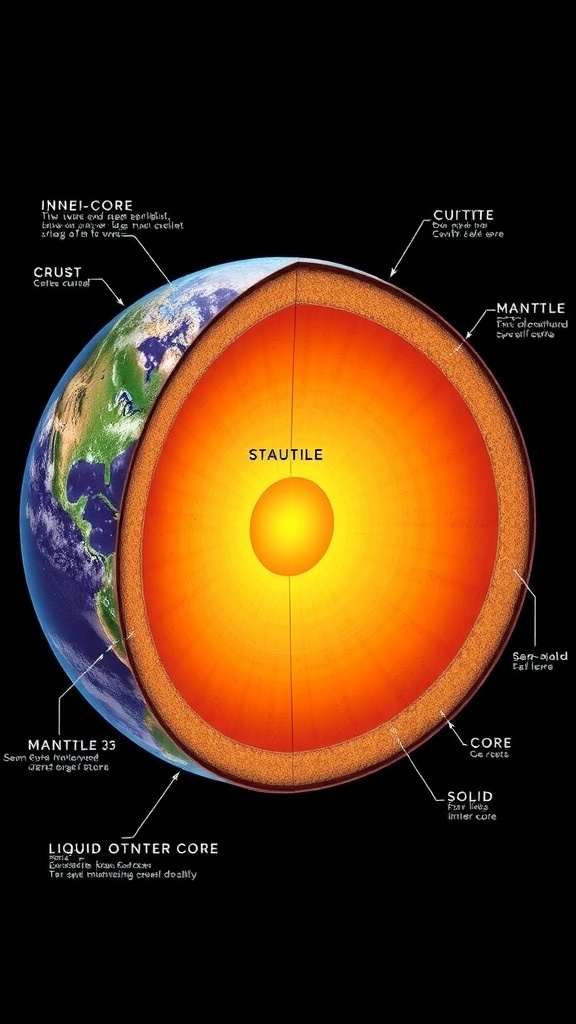
The Earth’s crust is the outermost layer, consisting of solid rock and minerals. Beneath it lies the mantle, a thick layer of semi-solid rock that flows slowly over time. At the center of the Earth is the core, which is divided into a liquid outer core and a solid inner core, primarily composed of iron and nickel.