

The crust is the outermost layer of the Earth, forming a thin shell over the geosphere. It is composed of a variety of rocks and minerals, playing a crucial role in supporting life and shaping the planet’s surface.
Understanding the crust is essential for studying geology, natural resources, and environmental science.
Understanding the Earth’s Crust
The Earth’s crust serves as the outermost layer, forming a thin shell that encases the planet’s interior.
It is composed of a diverse array of rocks and minerals, which are essential for sustaining life and shaping the surface features we observe today.
Studying the crust is vital for anyone interested in geology, natural resources, and environmental science.
This layer not only supports ecosystems but also plays a significant role in various geological processes.
Key Features of the Earth’s Crust
The crust exhibits considerable variation in thickness, being much thicker beneath continents compared to oceanic regions.
This distinction is crucial for understanding the different geological characteristics of land and sea.
There are two primary types of crust: continental crust, which is predominantly granitic, and oceanic crust, which is mainly basaltic.
These types interact with the underlying mantle, influencing tectonic activity and geological phenomena.
Composition of the Crust
The crust is rich in minerals such as feldspar, quartz, and mica, which contribute to its overall composition.
These minerals are found in various rock types, including igneous, sedimentary, and metamorphic rocks.
Understanding the specific types of rocks present in the crust is essential for geological studies and resource exploration.
Each rock type has unique properties that affect the Earth’s surface and subsurface processes.
Tectonic Plates and Their Boundaries
Tectonic plates are massive sections of the Earth’s crust that float on the semi-fluid mantle beneath.
These plates are constantly moving, albeit very slowly, and their interactions lead to various geological events.
The boundaries between tectonic plates are often sites of significant geological activity, including earthquakes and volcanic eruptions.
Studying these boundaries helps geologists predict and understand natural disasters.
Geological Features of the Crust
The Earth’s crust is home to numerous geological features, including mountains, valleys, and ocean ridges.
These features result from the dynamic processes of plate tectonics, erosion, and sedimentation.
Mountains, for instance, often form at convergent plate boundaries where two plates collide, while ocean ridges arise at divergent boundaries where plates move apart.
These features not only shape the landscape but also influence climate and ecosystems.
Importance of Studying the Crust
Understanding the crust is essential for various fields, including geology, environmental science, and natural resource management.
The minerals and resources found within the crust are vital for human civilization, providing materials for construction, technology, and energy.
By studying the crust, scientists can gain insights into Earth’s history, the processes that shape our planet, and the potential for natural resources.
This knowledge is crucial for sustainable development and environmental conservation.
Key Features of the Earth’s Crust
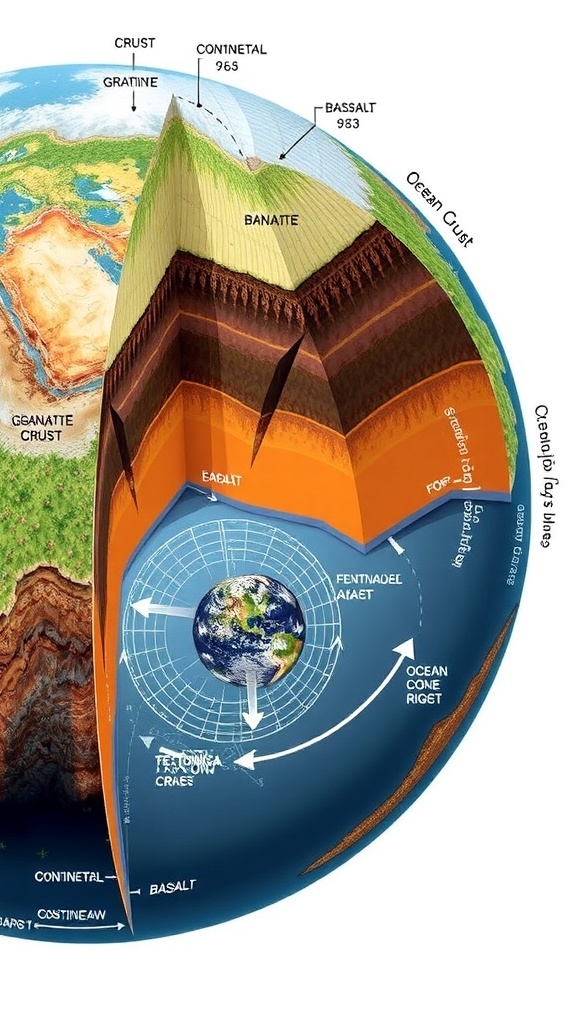
The Earth’s crust varies in thickness, being thicker under continents and thinner under oceans. It is divided into two types: continental crust, which is primarily granitic, and oceanic crust, which is mainly basaltic. The crust interacts with the mantle beneath it, influencing tectonic activity and geological processes.
Ingredients
- Continental crust (granite)
- Oceanic crust (basalt)
- Minerals (feldspar, quartz, mica)
- Rocks (igneous, sedimentary, metamorphic)
- Tectonic plates
Instructions
- Study the composition of the crust: Analyze the different types of rocks and minerals present.
- Examine the thickness variations: Measure the crust’s thickness in different geological settings.
- Explore tectonic activity: Investigate how the crust interacts with the mantle and tectonic plates.
Cook and Prep Times
- Study Duration: Varies based on research focus
- Importance: Essential for understanding Earth’s structure and processes
- Resources: Minerals and natural resources found in the crust