

The Earth’s crust is the outermost layer of our planet, composed of a variety of rocks and minerals. It plays a crucial role in supporting life and is where we find landforms, oceans, and ecosystems.
Understanding the Earth’s crust is essential for geology, environmental science, and natural resource management.
Understanding the Earth’s Crust
The Earth’s crust is the outermost layer, serving as the foundation for all terrestrial life.
It is composed of various rock types and minerals, which contribute to the diverse landscapes we observe.
This layer is relatively thin compared to the layers beneath it, with significant variations in thickness.
Under the oceans, the crust can be as thin as 5 kilometers, while under continental regions, it can reach up to 70 kilometers.
This disparity in thickness is crucial for understanding geological processes and the formation of different landforms.
Composition of the Crust
The crust is primarily made up of igneous, sedimentary, and metamorphic rocks.
Igneous rocks, such as granite and basalt, form from cooled magma and are prevalent in continental and oceanic crusts, respectively.
Sedimentary rocks, like limestone and sandstone, arise from the accumulation of sediments and are often found in layers.
Metamorphic rocks, including schist and gneiss, are formed under heat and pressure from existing rocks.
These varying rock types contribute to the crust’s complexity and influence the ecosystems that thrive on its surface.
Tectonic Plates and Their Boundaries
The Earth’s crust is divided into several tectonic plates that float on the semi-fluid mantle beneath.
These plates are constantly in motion, driven by convection currents in the mantle.
Their interactions can lead to various geological events, including earthquakes, mountain building, and volcanic activity.
Tectonic boundaries are classified into three main types: convergent, divergent, and transform.
At convergent boundaries, plates collide, often resulting in mountain ranges or subduction zones.
Divergent boundaries occur where plates move apart, creating new crust, while transform boundaries involve plates sliding past one another.
Geological Phenomena Related to the Crust
The movement of tectonic plates has profound effects on the Earth’s surface.
Earthquakes occur when stress builds up at plate boundaries and is suddenly released.
Volcanic eruptions can happen at both convergent and divergent boundaries, where magma finds its way to the surface.
These geological phenomena not only shape the landscape but also affect ecosystems and human activities.
Understanding these processes is vital for disaster preparedness and resource management.
Visualizing the Earth’s Layers
A detailed geological illustration can help visualize the Earth’s layers, particularly the crust.
Such illustrations typically depict the crust’s composition, including various rock types and minerals, alongside tectonic plates and their boundaries.
A cross-section view of the Earth can also highlight the mantle and core beneath the crust, providing a comprehensive understanding of our planet’s structure.
These visual aids are essential for students, educators, and anyone interested in geology, as they simplify complex concepts and enhance learning.
The Importance of Studying the Crust
Studying the Earth’s crust is crucial for multiple fields, including geology, environmental science, and natural resource management.
Insights gained from understanding the crust can inform us about natural resources, such as minerals and fossil fuels, and their sustainable extraction.
Furthermore, knowledge of geological processes helps in assessing natural hazards and developing strategies for mitigation.
By understanding the crust, we can better appreciate the dynamic nature of our planet and its impact on life.
Understanding the Earth’s Crust
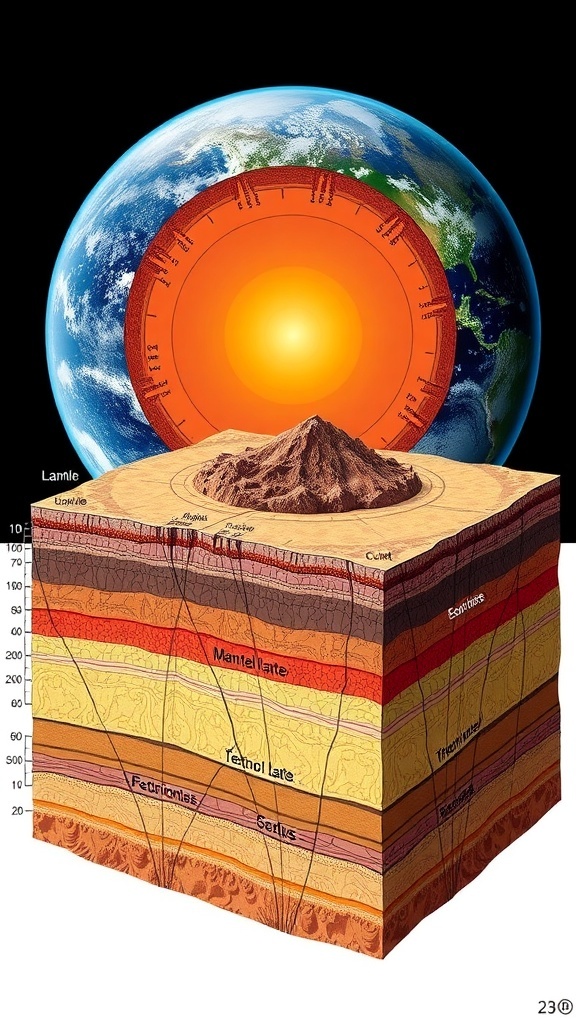
The Earth’s crust varies in thickness, being thinner under the oceans and thicker under continental landmasses. It is made up of tectonic plates that constantly shift, leading to geological phenomena such as earthquakes and volcanic eruptions.