

The Earth is composed of three main layers: the crust, mantle, and core. Each layer has distinct characteristics and plays a crucial role in the planet’s geology and dynamics.
Understanding these layers is fundamental in geology, as they influence tectonic activity, volcanic eruptions, and the overall structure of the Earth.
Overview of Earth’s Layers
The Earth is structured in three primary layers: the crust, mantle, and core. Each layer has unique properties that contribute to the planet’s overall functionality.
The crust, which is the outermost layer, is relatively thin compared to the layers beneath it. It consists of solid rock and minerals, forming the land we walk on and the ocean floors.
Below the crust lies the mantle, a substantial layer of semi-solid rock that flows slowly over geological time. This movement is crucial for tectonic activity, influencing earthquakes and volcanic eruptions.
The Crust: Earth’s Outer Shell
The crust is depicted in shades of brown and green, representing various rock types and vegetation. It varies in thickness, being thicker under continents and thinner under oceans.
This layer is where we find all terrestrial life, and it plays a significant role in supporting ecosystems. The crust is also where human activities occur, from agriculture to urban development.
Understanding the crust’s composition helps geologists predict how it will respond to natural forces, making it essential for assessing geological hazards.
The Mantle: A Thick Semi-Solid Layer
Represented in vibrant orange and yellow hues, the mantle is the thickest layer of the Earth. Its semi-solid nature allows it to flow slowly, which is vital for the movement of tectonic plates.
The mantle’s convection currents drive the movement of these plates, leading to the formation of mountains, ocean basins, and other geological features. This layer is also rich in silicate minerals, which contribute to its unique properties.
Studying the mantle provides insights into the Earth’s thermal dynamics and helps scientists understand the processes that shape our planet over millions of years.
The Core: The Heart of the Earth
The core is depicted as a central sphere, with a solid inner core and a liquid outer core, shown in metallic gray and gold tones. This layer is primarily composed of iron and nickel, giving it a distinct metallic character.
The outer core’s liquid state generates the Earth’s magnetic field through the movement of molten metals. This magnetic field protects the planet from solar radiation and is essential for life.
The inner core, being solid, is under immense pressure and temperature, creating conditions that are still not fully understood. Research into the core continues to reveal more about the Earth’s formation and evolution.
Importance of Understanding Earth’s Structure
Grasping the structure of the Earth is fundamental in geology and environmental science. Each layer interacts with the others, influencing everything from volcanic activity to the formation of natural resources.
By studying these layers, scientists can better predict geological events and understand the history of our planet. This knowledge is crucial for developing strategies to mitigate natural disasters and manage Earth’s resources sustainably.
Furthermore, insights gained from Earth’s layers can inform us about other planetary bodies, enhancing our understanding of the solar system and the universe.
Overview of Earth’s Layers
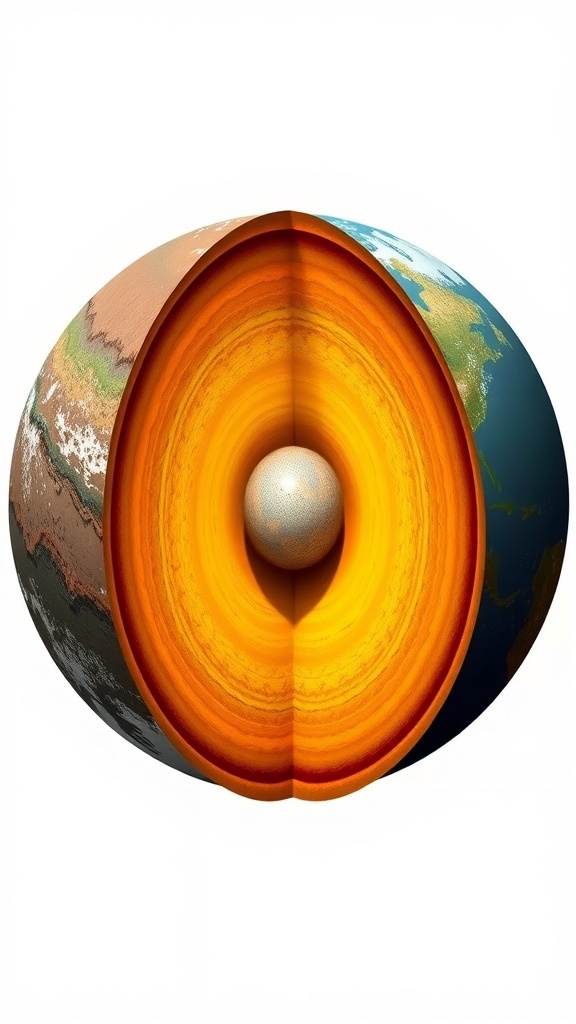
The crust is the outermost layer, consisting of solid rock and minerals. Beneath it lies the mantle, a thick layer of semi-solid rock that flows slowly over geological time. At the center is the core, composed mainly of iron and nickel, with a solid inner core and a liquid outer core.