

The Earth is composed of three main layers: the crust, mantle, and core. Each layer has distinct properties and plays a crucial role in the planet’s geology and dynamics.
Understanding these layers helps in comprehending geological processes such as plate tectonics, volcanic activity, and the Earth’s magnetic field.
Overview of Earth’s Layers
The Earth is structured in three primary layers: the crust, mantle, and core. Each layer possesses unique characteristics that contribute to the planet’s overall functionality.
The crust is the outermost layer, relatively thin compared to the layers beneath it. It consists mainly of solid rock and minerals, primarily granite and basalt. This layer is where we live and interact with the environment.
The Crust: Earth’s Surface Layer
The crust varies in thickness, ranging from about 5 to 70 kilometers. It is composed of a variety of rocks and minerals that form the continents and ocean floors.
This layer is crucial for supporting life, as it contains the resources necessary for ecosystems, including soil, water, and minerals.
The Mantle: The Thick, Flowing Layer
Beneath the crust lies the mantle, which extends approximately 2900 kilometers deep. This layer is semi-solid and composed mainly of silicate minerals.
The mantle is characterized by its ability to flow slowly over geological time, which plays a significant role in tectonic activity and the movement of the Earth’s plates.
The Core: Center of the Earth
The core is divided into two distinct parts: the outer core and the inner core. The outer core is liquid, while the inner core is solid, primarily made up of iron and nickel.
This core structure is essential for generating the Earth’s magnetic field, which protects the planet from solar radiation and helps maintain a stable environment.
Geological Processes and Their Importance
Understanding the composition and behavior of these layers is vital for comprehending geological processes such as plate tectonics and volcanic activity.
These processes influence everything from the formation of mountains to the occurrence of earthquakes, shaping the Earth’s surface over millions of years.
Visual Representation of Earth’s Structure
A cross-sectional illustration of the Earth effectively depicts the distinct layers: the thin crust on the surface, the thick mantle beneath, and the core at the center.
This visual representation aids in grasping the relationships between the layers and their respective functions within the Earth’s geology.
Overview of Earth’s Layers
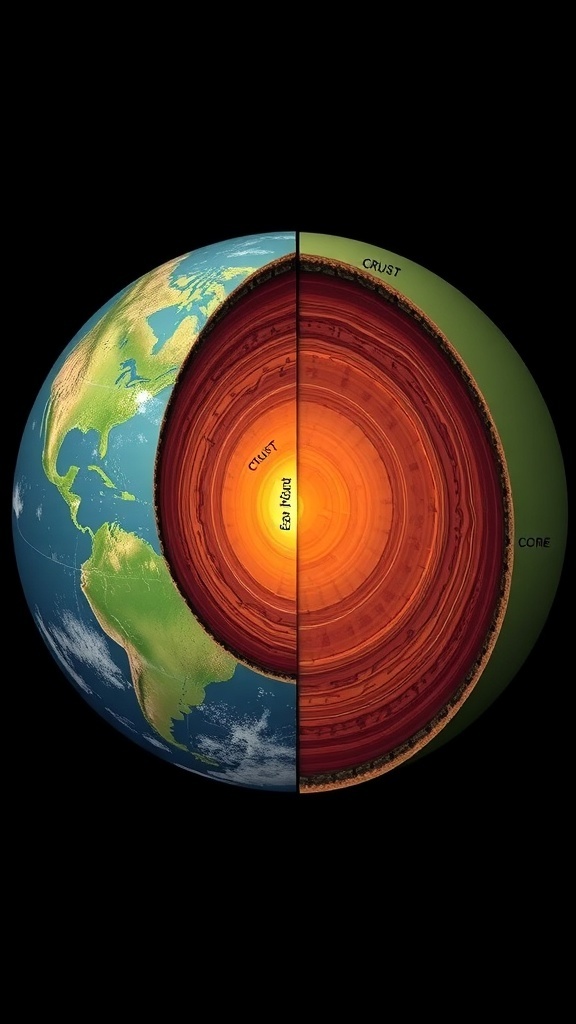
The crust is the outermost layer, consisting of solid rock and minerals. Beneath it lies the mantle, a thick layer of semi-solid rock that flows slowly over time. At the center is the core, composed primarily of iron and nickel, with a solid inner core and a liquid outer core.