

Earth is composed of three main layers: the crust, mantle, and core. Each layer has distinct characteristics and plays a crucial role in the planet’s structure and dynamics.
This overview provides a concise explanation of each layer, their composition, and their significance in the field of Earth science.
Layers of the Earth
Earth is structured in three primary layers: the crust, mantle, and core. Each layer possesses unique characteristics that contribute to the planet’s overall dynamics.
The crust is the outermost layer, where life exists. It varies in thickness, ranging from about 5 kilometers beneath the oceans to up to 70 kilometers under mountain ranges. This layer is composed of a variety of rocks, including granite, basalt, and sedimentary formations.
The Crust
The Earth’s crust is a thin shell that supports all terrestrial life. It is primarily composed of solid rock and minerals, which can be seen in the diverse landscapes we inhabit.
Different regions of the crust showcase various rock types, each represented in distinct colors in illustrations. This diversity reflects the geological processes that have shaped the Earth’s surface over millions of years.
The Mantle
Below the crust lies the mantle, extending to a depth of approximately 2,900 kilometers. This thick layer consists of semi-solid rock that flows slowly, allowing for tectonic movements.
The mantle is primarily made up of silicate rocks rich in iron and magnesium, such as peridotite. Its flowing texture is crucial for the movement of tectonic plates, which can lead to earthquakes and volcanic activity.
The Core
At the center of the Earth is the core, which is divided into two distinct parts: the outer core and the inner core. The outer core is liquid and plays a vital role in generating Earth’s magnetic field.
The inner core, in contrast, is solid due to the immense pressure at this depth. Composed mainly of iron and nickel, the core’s properties significantly influence the planet’s geology and magnetic behavior.
Visual Representation
A cross-sectional illustration of Earth vividly depicts these three layers. The crust is shown in various colors to represent different rock types, while the mantle is illustrated with flowing textures that convey its semi-solid nature.
The core is distinctly represented with a solid inner core and a liquid outer core, highlighting the contrasting states of matter that exist within our planet.
Significance in Earth Science
Understanding the structure of Earth’s layers is essential for geologists and scientists. Each layer’s composition and behavior provide insights into geological processes and the history of our planet.
Studying these layers helps us comprehend phenomena such as plate tectonics, volcanic eruptions, and the generation of Earth’s magnetic field, which are crucial for life on Earth.
Layers of the Earth
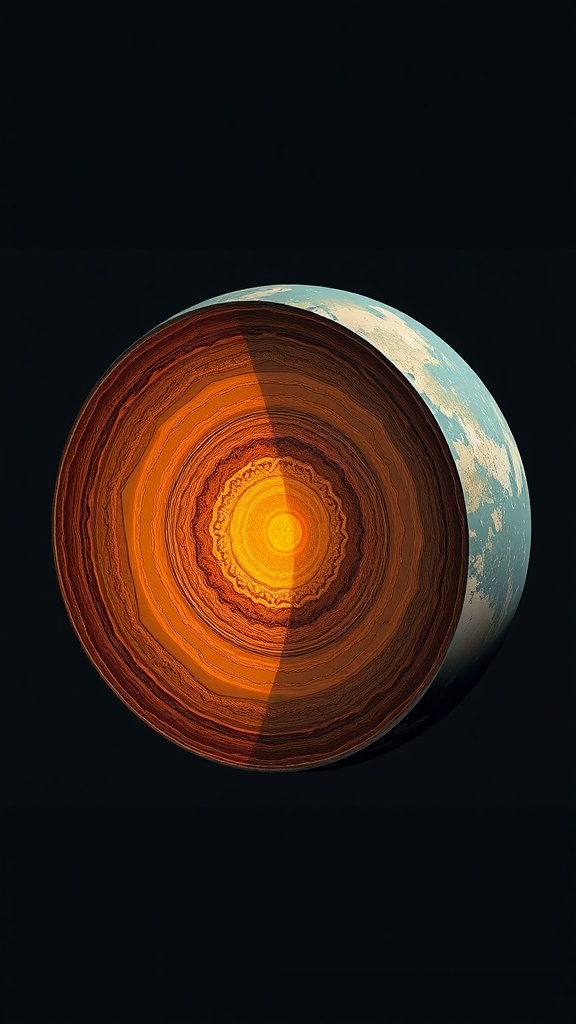
The crust is the outermost layer, consisting of solid rock and minerals. Beneath the crust lies the mantle, a thick layer of semi-solid rock that flows slowly over geological time. At the center of the Earth is the core, which is divided into a liquid outer core and a solid inner core, primarily composed of iron and nickel.