

The Earth’s crust is the outermost layer of our planet, consisting of two main types: continental crust and oceanic crust. Each type has distinct characteristics, composition, and thickness, playing a crucial role in the geology of Earth.
Continental crust is thicker and primarily composed of granitic rocks, while oceanic crust is thinner and mainly made up of basaltic rocks. Understanding these differences is essential for studying plate tectonics and the formation of various geological features.
Understanding the Earth’s Crust
The Earth’s crust serves as the outermost layer of our planet, playing a vital role in the overall structure of the Earth. It is primarily divided into two distinct types: continental crust and oceanic crust.
Each type exhibits unique characteristics, including differences in composition and thickness. These variations are crucial for understanding geological processes such as plate tectonics and the formation of various landforms.
Types of Earth’s Crust
Continental crust is significantly thicker than its oceanic counterpart, averaging between 30 to 50 kilometers in thickness. This type of crust forms the continents and is composed mainly of granitic rocks, which are less dense compared to the rocks found in oceanic crust.
In contrast, oceanic crust is much thinner, typically ranging from 5 to 10 kilometers in thickness. It forms the ocean floors and is primarily made up of basaltic rocks, which are denser and younger than those found in continental crust. These differences in thickness and composition are fundamental to the dynamics of Earth’s geology.
Composition of Continental Crust
The continental crust is a complex mixture of various rock types, including igneous, metamorphic, and sedimentary rocks. Common examples include granite, schist, and limestone, each contributing to the diverse geological features seen on land.
These rocks are often formed through processes such as volcanic activity, sedimentation, and metamorphism, leading to a rich tapestry of geological formations, including mountains, valleys, and plateaus.
Composition of Oceanic Crust
Oceanic crust, on the other hand, is primarily composed of basalt, which forms from the cooling and solidification of lava at mid-ocean ridges. This crust is generally younger than continental crust, as it is continuously created and destroyed through tectonic processes.
Additionally, oceanic crust features unique geological structures such as hydrothermal vents and abyssal plains, which are formed by the interaction of tectonic activity and ocean water.
Geological Features Associated with Each Crust Type
Each type of crust is associated with distinct geological features that reflect their formation processes. Continental crust is often characterized by mountain ranges, rift valleys, and sedimentary basins, which are shaped by tectonic forces and erosion over time.
Conversely, oceanic crust is marked by features such as mid-ocean ridges, deep-sea trenches, and volcanic islands. These features are the result of tectonic plate movements, including subduction and seafloor spreading, highlighting the dynamic nature of Earth’s geology.
Importance of Understanding Earth’s Crust
Grasping the differences between continental and oceanic crust is essential for various scientific fields, including geology, seismology, and environmental science.
This knowledge aids in predicting geological events such as earthquakes and volcanic eruptions, as well as understanding the distribution of natural resources and the impact of human activities on the Earth’s surface.
Types of Earth’s Crust
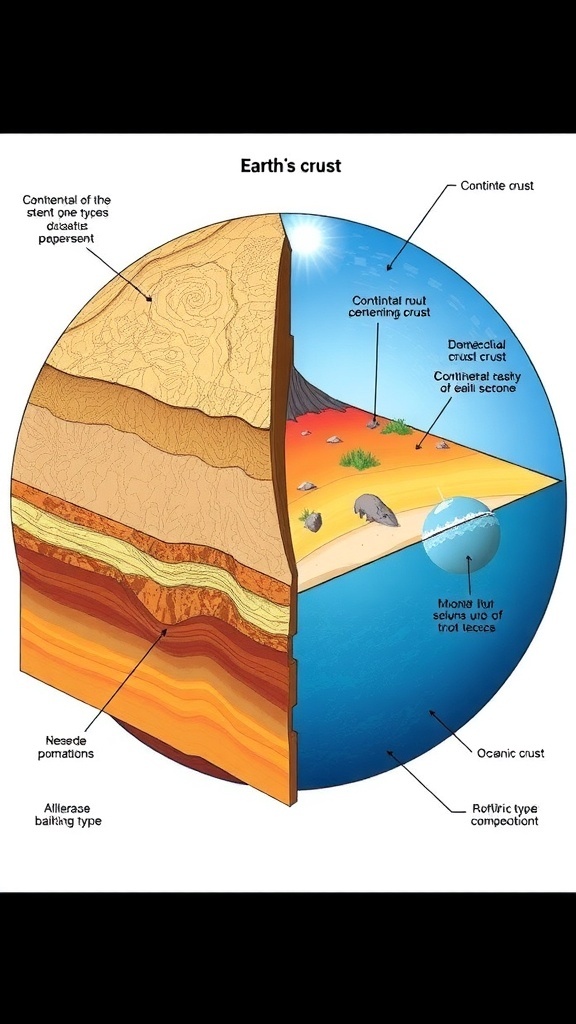
Continental crust averages about 30-50 kilometers in thickness and forms the continents, featuring a variety of rock types and geological formations. In contrast, oceanic crust is about 5-10 kilometers thick and forms the ocean floors, characterized by younger rocks that are continually being created at mid-ocean ridges.