

The Earth is composed of three main layers: the crust, mantle, and core. Each layer has distinct properties and plays a crucial role in the planet’s geology and dynamics.
Understanding these layers is essential for studying tectonic activity, volcanic eruptions, and the Earth’s magnetic field.
Overview of Earth’s Layers
The Earth is structured in three main layers: the crust, mantle, and core. Each layer has unique characteristics that contribute to the overall dynamics of our planet.
The crust, being the outermost layer, is composed of solid rocks and minerals. It varies in thickness, ranging from about 5 to 70 kilometers. This layer is primarily made up of granite on continents and basalt beneath oceans.
The Crust: Earth’s Outer Shell
The crust serves as the surface layer where we live, encompassing all terrestrial environments. Its composition is crucial for understanding geological processes and landforms.
Granite, found in continental regions, is less dense compared to basalt, which forms the oceanic crust. This difference in composition affects tectonic activity and the formation of mountains and ocean basins.
The Mantle: The Thick Layer Beneath
Beneath the crust lies the mantle, a substantial layer that extends approximately 2900 kilometers deep. Unlike the crust, the mantle is semi-solid and behaves like a viscous fluid over long periods.
This layer is rich in silicate minerals containing iron and magnesium, which contribute to its density and flow characteristics. The mantle plays a significant role in tectonic movements and the recycling of materials through processes like convection.
The Core: The Heart of the Earth
At the center of the Earth is the core, which is divided into two parts: the solid inner core and the liquid outer core. The core’s total thickness is about 3500 kilometers, making it a significant part of Earth’s structure.
Composed mainly of iron and nickel, the core is responsible for generating the Earth’s magnetic field through the movement of molten metal in the outer core. This magnetic field is vital for protecting the planet from solar radiation.
Visual Representation of Earth’s Layers
A cross-section diagram effectively illustrates the distinct layers of the Earth. The crust is depicted in light colors, showcasing its solid nature, while the mantle is represented in darker shades, highlighting its semi-solid state.
The core is illustrated in metallic hues, emphasizing its composition of iron and nickel. Such visual aids enhance our understanding of the Earth’s structure and the relationships between its layers.
Importance of Understanding Earth’s Layers
Studying the Earth’s layers is essential for various scientific fields, including geology, seismology, and environmental science. Knowledge of these layers aids in predicting tectonic activity and understanding volcanic eruptions.
Furthermore, insights into the core’s behavior contribute to our comprehension of the Earth’s magnetic field and its implications for life on the planet. This foundational knowledge is crucial for ongoing research and exploration of our dynamic Earth.
Overview of Earth’s Layers
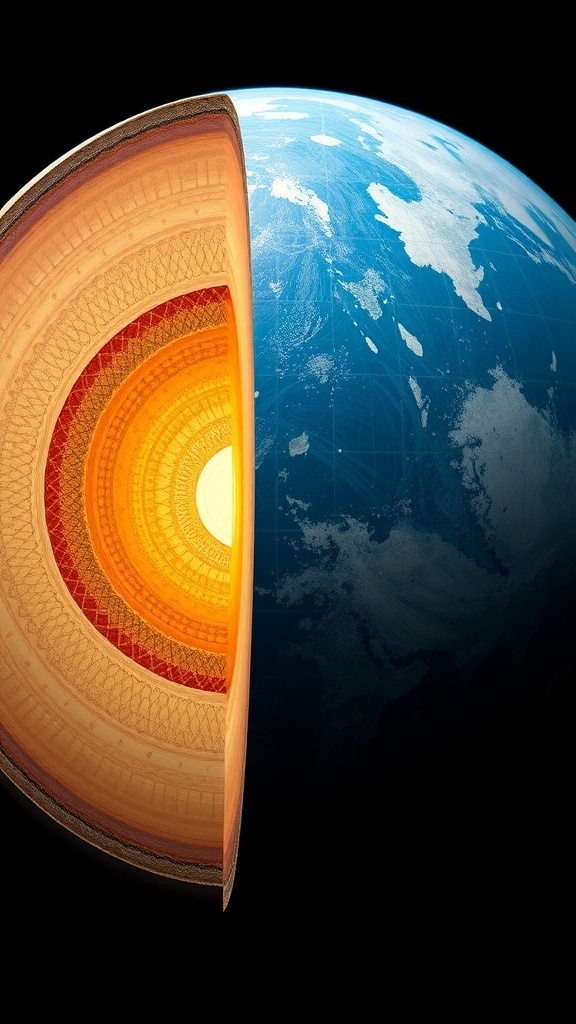
The crust is the outermost layer, consisting of solid rocks and minerals. Beneath it lies the mantle, a thick layer of semi-solid rock that flows slowly over geological time. At the center is the core, which is divided into a solid inner core and a liquid outer core, primarily composed of iron and nickel.